.png)


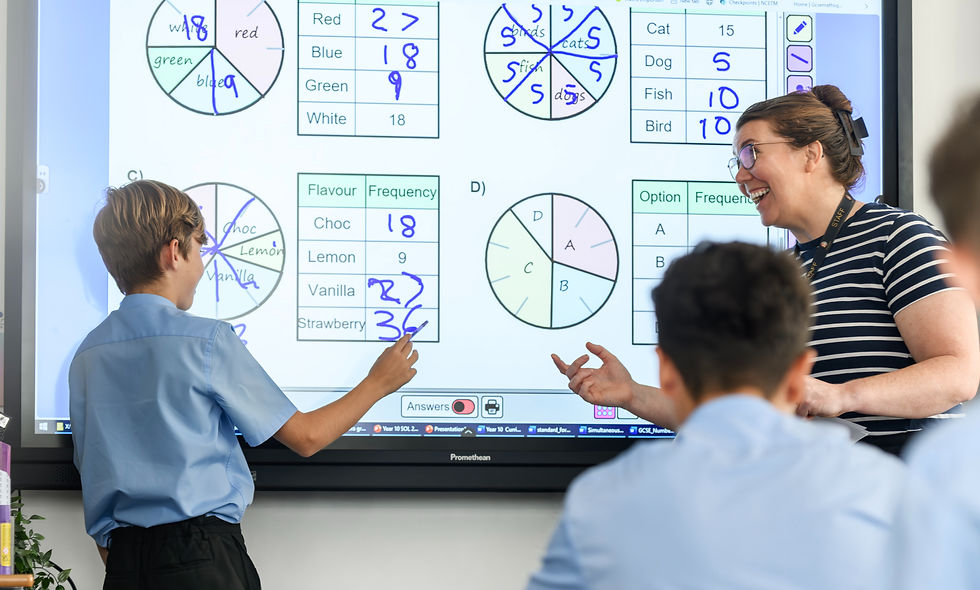
At Saints Peter and Paul Catholic High School, we aim to inspire all our students to enjoy mathematics and prepare them with skills to take into the rest of their lives.
Our ambitious curriculum is planned and sequenced to ensure that students have every opportunity to not only understand the underlying principles of mathematics, but to self-reflect and guide their own improvement.
Get to Know Us
“Without mathematics, there’s nothing you can do. Everything around you is mathematics. Everything around you is numbers.”
Shakuntala Devi
Our mathematics team are committed to providing students with every opportunity to maximise their potential, whatever their starting point, creating strong mathematicians who can apply their knowledge and reasoning to solve problems both in and out of the classroom.
Our curriculum:
-
Develops fluency and challenge through depth in fundamental mathematical concepts.
-
Fosters a love of making connections, logical reasoning, inquiry, and precision.
-
Encourages perseverance, resilience, and a growth mindset.
-
Equips students for real-world application, further study, and high aspiration.
-
Emphasises fairness and justice by closing attainment gaps and ensuring all students can achieve their potential.
KEY STAGE 3 (YEARS 7-9)
KS3 provides a coherent three-year programme that builds on Key Stage 2 learning and develops students' fluency, reasoning and problem-solving skills. Through carefully sequenced learning, students gain a secure understanding of six key mathematical strands in preparation for success at Key Stage 4.
The curriculum is structured around six key strands:
-
Number
-
Algebra
-
Ratio, Proportion and Rates of Change
-
Geometry and Measures
-
Probability
-
Statistics
Students are supported through:
-
End-of-unit Progress Checkers to assess understanding and identify next steps
-
Scaffolded challenge tasks that promote reasoning and mathematical thinking
-
Targeted intervention to support numeracy catch-up and address misconceptions
-
Regular opportunities to apply mathematical knowledge and problem-solving skills in a range of contexts
-
Weekly Sparx homework online
KEY STAGE 4 (YEARS 10-11)
KEY STAGE 4 (YEARS 10–11) builds on students' learning from Key Stage 3 through a carefully sequenced GCSE programme that develops fluency, reasoning and problem-solving skills. All pupils study GCSE Mathematics, with entry at Foundation or Higher tier, as appropriate, for the Edexcel GCSE Mathematics qualification.
The curriculum is structured around key GCSE topics, including:
-
Number
-
Algebra
-
Ratio, Proportion and Rates of Change
-
Geometry and Measures
-
Probability
-
Statistics
Students are supported through:
-
End-of-unit Progress Checkers to monitor understanding and identify next steps
-
Scaffolded challenge tasks that develop reasoning and mathematical thinking
-
Weekly Sparx homework online
-
Targeted intervention and small-group support to address misconceptions and build confidence
-
Weekly GCSE past paper questions completed as homework and reviewed in lessons to develop exam confidence and technique
-
Walk-and-talk mock examinations to explicitly model exam technique, question interpretation and effective problem-solving strategies
-
Fortnightly Elevate sessions providing bespoke exam coaching, revision strategies and targeted support for GCSE success
NUMERACY
We are committed to whole-school numeracy as a vital life skill:
-
Cross-curricular numeracy links with Science, Geography, Technology, and PE.
-
DEAN (Drop Everything and Number) initiatives to promote quick recall.
-
Form-time numeracy challenges and competitions.
-
Parental tips and home-learning tools to reinforce number skills.
In Mathematics, Catholic Social Teaching is embedded in our environment and culture in the classroom
Students grow in:
-
Spirituality: Discovering order, pattern, and finding peace and resilience, with emphasis on identifying that multiple methods can be correct so it is important to consider other points of view
-
Care for Creation: Making just and ethical decisions based on data and reasoning, and how statistics can inform environmental matters.
-
Social development: Listening, working together and collaborating on challenges, sharing strategies.
-
Option for the poor: Discussion about cultural influences in financial topics, using percentages to make comparisons and draw conclusions on fairness.
Enrichment Opportunities Include:
-
Monthly Maths Puzzle Challenge
-
Maths Week England
-
STEM project competitions
-
Cross-phase numeracy mentoring
-
University and employer visits, including the University of Liverpool
PERSONAL DEVELOPMENT & Catholic Values
IMPACT
We measure our Mathematics curriculum success by:
Service Name
Service Name
Service Name
Excellent progress and high GCSE outcomes.
Increased mathematical confidence and resilience.
Strong take-up of post-16 maths courses and STEM pathways.
A shared culture of high aspiration for all learners.